Showing posts with label 2018. Show all posts

Thursday, May 31, 2018

Week 22: So Far Away

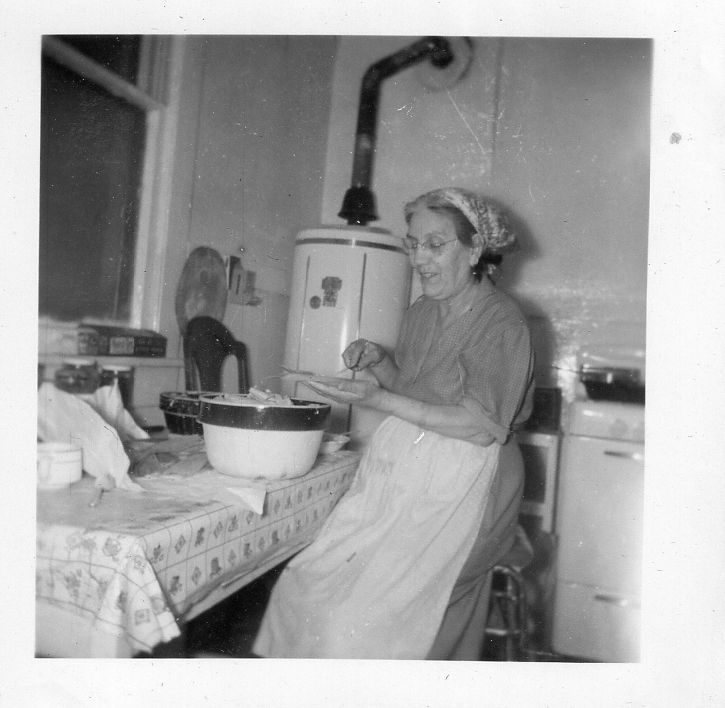
The only grandmother I ever knew was my Nana, Papias Peru Moskal.  She was my loving daytime caretaker for nearly 5 years before my parents divorced and my mother and I left El Paso for Memphis.  She continued to stay in touch with us until her mind became so feeble she was unable to take care of herself.  I was 16 when she died, and by then, time, distance, and youthful self-absorption tempered my emotional reaction to her death, though deep down nothing could diminish the bond I had with her.

El Paso was more than 1,000 miles away from Memphis, and of course, in the 1950's ordinary people traveled mostly by car, or perhaps by train.  My Nana didn't drive, and my mother, a single parent, couldn't afford for us to travel back to El Paso, and we didn't have a reliable car anyway. And upon reflection, my mom likely wanted to avoid an encounter with my dad and his new wife.

So in 1957, two years after our move to Memphis, my Uncle Bill, my dad's older brother, drove Nana to Memphis to see us.  Following today's interstate highways, Google Maps calculates a 15-17 hour drive from El Paso to Memphis, but it's doubtful he was able to take a route as direct or as swift as that.  Uncle Bill told me many years later that Nana sat in the back seat of his station wagon and said her rosary for the entire trip as he surely put the pedal to the metal to cover the miles as quickly as possible.

When they finally arrived at our apartment in Memphis, I remember being so happy to see them, especially Nana, and I was aware, for the first time in my life, that my cheeks hurt from smiling.  She brought me holy water from her church, and let me pick among several scarves she had packed.  She didn't care that I picked the most beautiful one.  That was my Nana.

I don't recall how long they stayed, probably a week, since I'm sure Uncle Bill needed to get back to work, but he and his trusty Polaroid camera documented the visit for posterity.  My mother cried when they left knowing somehow this would be the last time we would see Nana.  However, Uncle Bill continued to stay in touch with us, and would occasionally visit, until his death in 1995.

When I started my genealogy research, I thought because I knew my grandmother, that I knew quite a bit about her.  I knew she was born in Mexico, and that she was a devout Catholic who attended mass everyday.  But I really knew nothing.  Somewhere along the way, either my uncle or my cousin, Anita, (his daughter) had given me a copy of Nana's birth certificate.  It was invaluable as a starting point, because in Mexico the births recorded by the church included the names of parents as well as grandparents, a great start for our family tree.

Nana was born in February 1888 according to her official birth certificate, but as I researched further, it amused me to see that on her marriage certificates and census records, she took liberties with her birth year, stating she was born either in 1892, 1894, and 1896.  I wonder if my grandfather ever knew she was actually seven years older than he was.

I learned from Anita's research that our grandmother had actually married a man named Juan Beltran in 1913 prior to marrying our grandfather in 1920.  She and Juan married in El Paso, and I presume, although I don't know for sure, that she had left her town of Casas Grandes because of the Mexican revolution as many Mexicans from Chihuahua fled to the U.S.  We don't know what happened to Juan. There is a Juan Beltran named in several newspaper articles who fought with Pancho Villa, but I'm doubtful that would be the same person. It's hard for me to grasp that Nana and Juan might have divorced, given her deep religious convictions, at least from my vantage point (see rosaries and holy water above!).  But men named Juan Beltran seems endless and I've not yet located a death certificate that fits that timeframe.

That distance of 1,000+ miles was a real impediment to learning first hand of my grandmother's family history, given the lengthy mode of travel and the prohibitive costs of long distance phone calls back in the day.  I know it would have been fascinating to hear about her childhood in Mexico with brothers and sisters and cousins too numerous to count.  Like many of us family researchers, I wish I could ask these questions now.


Nana and (silly) me, Memphis 1957
Nana and me circa 1953


Tuesday, April 24, 2018

Week 17: Cemetery

Hickory Grove


I grew up hearing about Hickory Grove, the cemetery in rural southern Arkansas (Ashley County) where my mother's people are buried.  There is no charge for a plot, but you must pay for the actual burial, and there are other families buried there besides mine.

Among my mother's ancestors buried there is my grandmother, Ruby Little Leary.  It was a point of much consternation for years that Ruby, a widow who died in 1939 from tuberculosis, didn't have a marker until nearly 30 years after her death.  It's unclear to me how that was finally resolved, although I believe it may have been a family effort, involving contributions from various cousins and my mother.

My first visit to Hickory Grove was in 1979 upon my mother's death. My husband, Larry, and I followed a caravan of relatives on the 5-hour drive from Memphis, TN to Bastrop, LA where we spent the night with my great aunt, Edna, and her second husband, Tom.  Edna and her first husband, Fabe, had been my mother's guardian after Ruby died.

The next day we followed the same relatives across the state line for my mother's funeral at Hickory Grove.  It was an unimpressive affair as I recall. I do remember Aunt Edna remarking, as we lingered afterwards at the cemetery visiting with relatives, she "reckoned" we should leave since the grave diggers would not lower my mother's coffin into the ground until we were gone. We stayed one more night with Aunt Edna, and as we left the next day, we stopped and ordered a monument for my mother.  I didn't want her to suffer the same apparent injustice her own mother had suffered.  And who knew if or when I would ever return to this out of the way place.


As it turns out I've been back twice since then, once in 1998 when I buttonholed my mother's first cousin, Rudy, to make the trip with me. In the nearly 20 years since my mom had passed, Rudy had also buried his own mother (sweet Aunt Edna) as well as his first wife, Jeanne, at Hickory Grove.   I naively agreed for him to make our overnight arrangements, which turned into a comedy of errors. His original plans for us to stay with cousins fell through, a fact I did not know until I picked him up to start our trip.  I just presumed we would find a motel then, but after we arrived in the little town of Bastrop, LA, he got on the phone and, I guess, called everyone he ever knew until someone took pity on him and agreed to give us shelter for the night.   It was the filthiest house I've ever seen (and believe me when I say I am no domestic diva).  But on very short notice she baked a cake for us, and fed us breakfast the next morning.  And maybe if she had gotten more than an hour's notice, she would have swept up the crumbs, dog hair,  and dust bunnies that covered the floors.  So, really.  Who am I to complain?

Our visit to the cemetery was brief, and it seemed about as nondescript as it had in 1979.  On the way out of town, Rudy directed me to a local bank where we both made a deposit to a bank account established for maintaining the cemetery.  It had never occurred to me until then that indeed the upkeep was not free.

In spite of all the confusion surrounding our lodging, I enjoyed spending the 10 hours round trip with my cousin.  He was normally taciturn, but on our ride down and back, he enlightened me about different Mississippi personalities, including B.B. King, Jim Henson, and Jerry Rice.  He also shocked me with family history about a "non-parental event" in the not too distant past!

As we passed back through Indianola on our return, we narrowly missed being sideswiped by a large SUV.  I was driving a rental car and all I could think about was having declined all the optional rental insurance.  Then arriving back at Rudy's home, he realized he hadn't thought to bring house keys with him, and his wife was not yet home from work.  So I watched as this lithe 75-year old man managed to break in to his own home by stacking things collected from around the yard and wiggling his way in through the kitchen window.  I was relieved to get back to the relative tranquility of my friend's house in Memphis.

In 2016, Larry and I were planning a road trip to Memphis to attend a family reunion, and he agreed to a side trip to Hickory Grove.  By this time, I was interested in my family genealogy, and had more knowledge of my mother's family history, so I was actually relishing this part of the trip.  I took my grandmother's old photo albums to the reunion with me, and spent some time with the only living cousin of my mother's generation, Rudy's younger brother.  Although his vision was not good, he made his best effort and gave me names of some of the people in the photos, adding a little color by recounting what he could about a few.  I tried to write down much of what he said, but I know I missed a lot.

My husband and I left Memphis a few days later, and stopped to visit the B.B. King Museum in Indianola, MS.  We had seen him perform numerous times, so it was a joy to tour the museum.  We ate lunch at the Blue Biscuit across the street where I had some of the best fried okra ever.  We were entertained by the owner, Harlan, who filled us in on the music scene there and said it was hard to compete with Morgan Freeman's club up the road in Clarksdale.

We eventually got on our way and drove on to spend Halloween night in Monroe, LA, the largest town near Hickory Grove.

After breakfast the next morning at the local IHOP, as we were heading to the cemetery, we stopped at a nearby Home Depot and bought several pots of mums to plant on the graves of my mother, grandmother, Aunt Edna, and Jeanne.  Since we hadn't thought this through, we also had to buy a shovel!

I had gotten directions to the cemetery from its Facebook page, and fortunately that included the GPS coordinates.  Once we turned off the main road from Monroe leading to Crossett, AR, we turned twice on the wrong dirt roads. Having those GPS coordinates kept us moving until we finally saw the nice wooden sign showing us the way.


As we turned into the cemetery there was a pickup truck with a couple of people sitting in it; they claimed they were looking for a particular grave and couldn't find it and pulled away.  Since that time, I've read that occasionally there are people who take advantage of the remoteness of the cemetery to do who knows what.

The cemetery itself sits in the middle of a pine forest, five acres of flat land, with very little in the way of shrubbery or shade trees.  (Mercifully, there's some type of evergreen tree that gives shade to many of the Wombles and Littles.)  There's a gravel road that circles through the cemetery in one direction. We didn't have to drive too far before my husband spotted a marker with LITTLE on it, one of the surnames of my mother's family members.  So we pulled over and walked around looking at the various gravestones.  My grandmother was the youngest of 10 children, and several of her siblings are buried there.  So are my great-grandparents, and 2x grandparents.

Other than not bringing a shovel with us from home, we were otherwise well prepared to spend a few hours there.  It was a mild autumn day, sunny but not too hot or humid.  While Larry was digging up the hard soil to plant the mums, I got out the materials I had packed to make stone rubbings.  Besides my mother's and grandmother's markers, I also made rubbings on the stone of my 2x grandfather, Elisha R. Womble, 1836-1926.


I ruminated over the crude stones for Aunt Edna's two young children that looked as if they had been etched by hand, wondering if Fabe had made them as best as he could.  I sat in a folding chair and had a nice visit with Aunt Edna and Jeanne; then poured my heart out to my mom, crying all the while. Larry and I wondered about the significance of the butterflies that flew about landing here and there on the mums and Larry's shoes.


And then...mums planted, rubbings completed, prayers said, we packed up and pulled away.  I had kept the receipt from the deposit I had made to the bank in 1998, so we made a stop there only to find that the account had been closed.  After we returned home, I found out through the cemetery's Facebook page where to make a donation.  Now the cemetery has tax exempt status with the IRS, and I've encouraged my cousins to donate as well.  Yes, it appears I've become "that relative" who wants everyone to share the joy of learning our family history.

Rather than wait another 17-18 years for our next visit, we're planning to go back this fall when we once again have a trip scheduled to Memphis.  That afternoon in 2016 spent at Hickory Grove among my ancestors was really significant for me, and I hope this one coming up will be just as memorable.

--------------------------------------------------------------------------------------------


Sunday, April 15, 2018

Week 15: Taxes


My mother, who died in 1979, worked her entire life as a secretary/stenographer and, as an extension of those skills, left behind well organized files. Going through her papers for the umpteenth time, I stopped to look at the business sized enveloped labeled "Tax Returns", stuffed with Forms 1040 dating back to 1948, the year she and my dad got married.

I found it interesting, and sad as well, to see her salary progress from earning $3,200 in 1948 working for the Texas & New Orleans Railroad in El Paso, TX, and topping out in 1972 at a little more than $6,500 as a clerk for the federal government in Memphis, TN.  Such was the life for a divorced woman, a single parent with lots of smarts, but only a high school education.  It's also a statement about the time and place(s) where she lived too.

Perusing these tax returns, I learned where she and my dad worked in El Paso.  I found the addresses where they lived before I was born, and before they bought their first and only house together.  And from those addresses, I can deduce they bought their house sometime in 1953.  In 1952 they claimed a combined income in excess of $8,000, a very comfortable income for a small family of 3 in El Paso, I would think. Their earnings were only slightly less in 1953.  I learned that my mom usually earned more than my dad.

Then...(cue dark clouds and ominous music)...things went bad for them in 1954 and 1955. It looks like they filed a joint return in 1954, but the 1955 return is filed in my mom's name only.  The attached earnings statements were from El Paso, Seattle, and Memphis. My parents separated, then divorced in July 1955, with my mother removing us from the drama in El Paso and settling in Memphis where she had a very small network of cousins she could rely on for support.  Memphis was also a big enough city where she could easily find employment, as opposed to the small towns in Louisiana where she grew up.

Her 1956 tax return includes a typed explanation of why she claimed a deduction for license plates from both Texas and Tennessee, a result of my father not living up to his end of their property agreement.  I remember the event when that car, a two-tone 1954 Mercury, was repossessed on a weekend while I played out front and watched, incredulous, as a strange man went into the apartment building, then returned and drove away with our car!

I can see it took her 5-6 years to regain the earning power she lost when she left her job at the railroad in El Paso and went to work in Memphis for several of the oil companies that had offices there.  She also would occasionally work a half day on Saturdays to earn a few extra dollars.  I would oftentimes get to go with her to those Saturday jobs, and I would run the halls of the empty office building, where my footsteps echoed off the marble floors and high ceilings.  I would always beg for a nickel to buy a cold bottle of Coca-Cola from the vending machine downstairs, sometimes starting to badger her just as we entered the building.  If I could sit still long enough, I would marvel at her taking shorthand and transcribing her scratches on the steno pad to the typewriter with lightning speed.  I heard more than once about her outstanding secretarial skills.  I think I could probably match her typing speed, but I never mastered shorthand well enough to get close to her expertise!

In 1966, a friend referred my mom for a job with a Federal bankruptcy judge, who also happened to be the friend's father-in-law.  My mom had to take a cut in pay, but the benefits such as health insurance, were enticing. There were several additional W-2s attached to her 1966 return for side jobs she took.  The side jobs continued for another year or two, then stopped.  This may be because of the built-in "step increases" the government offered, so her salary increased a little every year.  Or perhaps the timing coincided with my starting college, where I was able to live at home and work on campus to cover all my expenses.  At the same time, her health began to decline, and in 1972 she qualified for a disability pension.

Even though her disability and Social Security incomes were less than she had earned her last years of working, it was sufficient for her to live modestly.  She certainly deserved those last few years of not having to struggle financially.
Charlotte Leary Moskal (circa 1964)


Saturday, March 24, 2018

WEEK 12: Misfortune


DICK LEARY

DICK & RUBY LEARY


IF IT WEREN'T FOR BAD LUCK, I'D HAVE NO LUCK AT ALL


By the time we get to Week 52 of this writing exercise, everyone will probably be sick of my stories about my grandfather, Dick Leary.  You're probably already wondering if I have no other ancestors about which I could write.  But of my ancestors I've studied so far, he lived the most colorful life of any, and in my opinion, had the most misfortune.

I wrote last week's essay topic, "Lucky", about using a transcript of my grandfather's interview for his job as a Prohibition agent to help me fill in some details of his life.  One detail was an event that most likely led to his poor health for the next four years, and ultimately his premature death.

I had always been told my grandfather died of stomach cancer in 1928 at the age of 35.  The death announcement in the newspaper offered the explanation that the extreme climate change of his being transferred from the Philippines to Siberia had caused him to contract some unspecified illness.   However, his death certificate stated the official cause of death was "Toxemia", with a secondary cause listed as "Acute Yellow Atrophy of the Liver".  Another doctor who examined him about two weeks prior to his death speculated he had "cancer of the pyloris [sic] from long continued irritation from recurring duodenal ulcers."

When I started looking through family papers, I found my grandmother, Ruby, and later my mother, had held on to a an old yellowed folder of papers belonging to Dick Leary which included, among other things, correspondence with the Veterans Bureau as it was known then, as well as letters from various Veterans' hospitals. The papers were in pretty good shape, but not in any particular order, and were secured at the top of the folder with a two-prong metal fastener, the kind where the ends fold down towards the middle, with the little slides to secure them.

I disassembled the folder and painstakingly sorted out the various papers in date sequence. The earliest was in 1922.  The latest, in 1939, was addressed to my grandmother, who was at this point near death herself, cloistered in a tuberculosis sanitorium near Fort Smith, Arkansas.

As I went through the letters and forms, I saw that bureaucratic red tape and the postal service being what it was at the time, correspondence oftentimes crossed in the mail, or frequently reached my grandfather's last known address after he had moved on.

To begin at the beginning, when he was discharged from the Army in 1919,  his "condition when discharged" was listed as "Poor" with no explanation, and he was discharged with only a 5% disability, evidently for losing the tips of one or two fingers in an accident in the Philippines.  Then there follows a 3 year gap in the paper trail.

It picks up in November 1922 when a doctor at the Health Dept. in Bakersfield, CA certified Dick is a "disabled ex-service man and unable to perform any labor".  I have no idea to whom the paper was addressed or why it was completed, although it may have been for the purpose of securing additional disability compensation from the Veterans Bureau.  There were several occasions throughout when he wrote to the Veteran's Bureau to inform them he'd been unable to work, and asked for increased compensation.  Then the paper trail again goes dark until August 1924, when the Veterans Bureau authorizes his travel from Omaha, NE to Waukesha, WI for hospital admission.

Just a few months later, in October 1924, he was hired by the Narcotics Division, IRS, and was assigned alternately to Baltimore, Boston, and El Paso offices.  He asked to be reassigned from Boston back to El Paso because he developed "severe laryngitis and pharyngitis".  In transit from Boston to El Paso, he had to detrain in Atlanta, and was treated for 3 days by a local doctor for continuous vomiting, diagnosed as "intestinal toxemia".  By March 1925, only 6 months after he was hired, his superiors in the Narcotics Division at IRS in El Paso, TX, advised him to resign without prejudice due to poor health.  His immediate supervisor commented on his unique qualifications for the job and the high quality of his work.

In 1925, because of recently passed legislation, the Veterans Bureau added psychoneurosis (referring to shell shock, I presume), to his diagnosis.  In the summer,  Dick wrote to the Veterans Bureau, from William Beaumont Hospital in El Paso, where he had been a patient for several weeks.  He had been informed he "must have an operation to include removal of the appendix and gall bladder".   He asked to be transferred to a Veterans Hospital near his mother's home in Niagara Falls for the surgery, not wanting to cause undue worry to her.  

He traveled from El Paso to Niagara in August, but upon arriving was so ill he saw a local doctor and had emergency surgery.  However, after the operation he said he found the diagnosis of his condition was not correct, as he "continued to vomit continuously and was again hospitalized".  At this point the doctor admitted he didn't know what was wrong with him, and was afraid he wouldn't recover.  In mid-August, he finally "took matters in my own hands and had my mother bring me to the Mayo Brothers".  According to Dick, "it is apparent that it is largely a nervous condition...<my> disability is considered a psychoneurotic condition".  And in the midst of this, he was exchanging correspondence with the IRS about being reinstated, although that never came to pass.

Whatever his condition was mid-September at the Mayo Clinic, he was able to make his way to Silver City, NM.  This is where he met my grandmother,  Ruby, who had traveled from Louisiana with her sister who was seeking treatment for tuberculosis.  My grandparents could not have known each other too long before deciding to marry on Nov. 11, 1925.   Then early in 1926, he was admitted twice, in January and in March, to the Veterans Hospital at Fort Bayard, NM, checking himself out the 2nd time "against medical advice".

From here, he and my grandmother wandered westward, and the next correspondence was addressed to him in Palo Alto, CA in May 1926, then in August in Sacramento.   My grandmother gave birth to my mother in Sacramento on August 31, 1926.  With the birth of my mother, and his health issues, I guess he thought it would be wise to have some life insurance, since he received some correspondence from the Veterans Bureau about action needed to reinstate his insurance.  Dick also received some personal correspondence later in 1926 from former IRS co-workers, both of whom offered their regrets to hear of his "condition" and "ill health".

In early 1927, he received a notice from the Veterans Bureau addressed to him at my grandmother's parents' home in New Orleans.  I've been told that my mother and grandmother lived for a time with her parents.

In May 1927, Dick was on the move again, as there's a note from doctors in Texarkana, AR/TX attesting to Leary being under their care for 4 days "on account of painful neuritis; given three hypodermics of 1/4 gr morphine each day".  He later received correspondence at two different addresses in Dallas, TX.

In October, he once more was admitted to a Veterans Hospital, this time in Muskogee, OK, again checking  himself out AMA after two weeks.   Then the next correspondence is addressed to him in Silver City, NM.

In March 1928, he returned to his mother's home in Niagara Falls to live with his mother until he died in August.  I suppose the cost and time involved to travel from New Orleans to Buffalo, and perhaps having no one to care for my mother in her absence, prohibited my grandmother from making the trip for his funeral.

In June, a few months before his death, the Veterans Bureau had written him that their records showed that he never submitted an application for the reinstatement of his life insurance (which would have been for $5,000), which had been lapsed since his discharge from the service in 1919.  Since there's earlier correspondence on this subject, I don't know why he didn't follow up.  It's possible that he submitted a request and it got lost, or that it never caught up with him, or between new family responsibilities and his poor health, it just slipped through the cracks.

After Dick died, Ruby tried for years without much success to get survivors' benefits for herself and my mother.  She engaged lawyers, Congressmen, and the American Legion to fight on her behalf with the Veterans Bureau.  But to no avail.  The Veterans Bureau did not agree that Dick's disability of neuropsychosis was the cause of his death.

The exact words from their letter to Ruby were, "direct payments of compensation terminated by his death and as it was decided that the veteran's death was not due nor incident to his military service, death compensation is not payable to his dependents including yourself.  You are also advised that...the veteran permitted his insurance to lapse...It is, therefore, regretted to advise you also that no insurance is payable in this case."   (This whole statement is so distasteful!)

However, because of legislation only referred to as the Act of June 28, 1934, Ruby was eventually awarded $30 from the date of the passage of the law, and $22 from August 31, 1944, when my mother would have turned 18.

Dick's disability pension was based on losing the ends of two fingers and a "nervous condition".  He stated in his IRS interview that he was in a couple of skirmishes in Siberia, and there's evidence that he was disturbed by loud sounds, such as fireworks.

In that 1924 job interview, Dick also described the following event.  "While in Siberia, my horse struck a large hole, and as I went to quit him, I slipped under him, and he fell on top of me, full weight.  I was ruptured, and that resulted in an operation.  They invalided me home, and I have finally worked out of it."  Except, of course, he hadn't.

I have little doubt that this accident resulted in his recurring illnesses.   Perhaps the operation he had before being sent home was botched in some way, or perhaps the injuries were just so severe that he was never able to totally recover.  Why this wasn't a service related injury, and why it was never explored as a cause of all his illness is beyond me.


Friday, March 16, 2018

WEEK 11: Lucky

Lucky....Lucky ME


You know the meme that's been going around for some time about the dates on your tombstone, and the important thing is the "dash" between the dates?  Hunting down a history for my grandfather, Dick Leary, has been all about the dash.  It was relatively easy to discern his birth and death dates, but from the time of his birth in 1892 until his death in 1928, Dick Leary's genealogical trail has shed sparse details.  Besides a small folder of his correspondence with the Veteran's Administration, and with his employer, the Internal Revenue Service, and a few letters of reference (all attesting to his integrity and "grit"), I had little to go on in my search.  Although I could track down his mother, aunt, grandmother, and his only sister in census and other records dating back to the 1870s, Dick's name was never recorded.  I surmised from a few newspaper clippings that he did his government work under several aliases, just to complicate my search.

His army discharge papers showed he had enlisted in the Army in 1916 in Long Beach, CA, at nearly 24 years old.  My challenge was to unravel how and why in the world he traveled from Buffalo, NY and ended up on the west coast.

I ordered his military records from NARA, and at the same time requested his official (civilian) personnel folder in the hopes I could find more information about his family.  I particularly wanted a definitive answer to his father's name, known both as Patrick Leary and Edward Leary.  I hoped between Dick's military and civilian work records, I could track him across the country.

The military records were non-existent according to the form letter I received that stated they were in the section that burned in 1973.  So I waited for the civilian records.

When the personnel records arrived, I could hardly wait to come inside from the mailbox to rip open the official looking brown envelope.  Beginning at the front, I looked carefully at each page.  I was feeling disappointed as I moved from one page to the next,  looking for any hint of personal information to give me a clue about who this man was, or links to other family members' names or addresses.  But I found they were mostly standard government forms documenting personnel actions, assignments to different locales, etc.   Finally, as I turned over one form, I saw a plain white piece of paper with doubled spaced typed lines.  I could hardly believe my eyes when I realized that in the 34 pages they sent, literally the last document at the back of the folder held seven pages of a typed transcript of Dick's interview in 1924 for the position of Prohibition Agent in El Paso, TX.  At last, here was some of the information to fill in the "dash"!

In this interview, my grandfather told of running away from home when he was about 14.  (From my research, I believe this may have coincided with his mother's marriage to her second husband.)  He said he sold newspapers and shined shoes, worked as a cook and waiter.  He described becoming an apprentice show card artist, learning from reading books, explaining it was a type of sign writing for stores to highlight items for sale.  I'd never heard of show card writing, but there were plenty of links on Google.   He talked of working on various ranches in the southwest USA along the border of Mexico, learning to speak Spanish along the way.  He outlined his military experiences in the Philippines and Siberia.  (More about that in next week's challenge, "Misfortune".)

I couldn't believe how lucky I was to get this information, and especially to be able to read it in the "first person" with my grandfather's own words.  While these papers have answered some of my questions, they've also created more to be answered.  And so I will keep searching to fill in the dash.
DAPPER DICK LEARY

Saturday, February 24, 2018

WEEK 4: Invite to dinner


After my parents divorced, my mother and I moved to Memphis, TN.  My mother, known as Miss Charlotte, "Miz" Moskal, or Aunt Charlotte (always pronounced like "aint" in that part of the south) was a wonderful cook, and continued to make the dishes she had learned to cook in El Paso from her Mexican mother-in-law, my grandmother, Papias.  

This must have been a seemingly exotic cuisine in the deep south in 1955, but with the exception of one ingredient, everything else she needed could be purchased at our corner grocery store: chili powder, cheddar cheese, onions, lettuce, ground meat, beans, rice.  

Interestingly, as I sat down to write about this, I dredged up a vague memory that for a while my Uncle Bill, her former brother-in-law, would ship us the corn tortillas, because that was the one critical ingredient she couldn’t find locally.  No tortillas; no Tex-Mex.  Whenever the tortillas arrived, we would feast that weekend. 

She made her enchilada sauce starting with a roux, then added chili powder and a few other ingredients, and this is the recipe she passed down to me.  She told me at the time that, while it wasn't the same recipe my grandmother used, it tasted pretty close to the way my grandmother's did.  I was astonished when I returned  to El Paso as an adult, and watched the steps my aunt went through to make her sauce, which involved roasting and soaking the peppers, undoubtedly more authentic, and a lot more work.  And anyway, I'm positive those peppers were not available from Franceschini's Grocery in the 1950's.

My mom made her own taco shells by folding the tortillas in half and holding the bottom in the hot grease until they hardened enough to be released to finish crisping. (No Old El Paso or Ortega pre-made shells back in the day.) To make the enchiladas, she would dip the tortillas quickly in hot grease just long enough to soften them before dousing them with her homemade enchilada sauce (red sauce only!).  Shredded cheese and chopped onions comprised the filling.  This was several hours of prep and cleanup, definitely no small feat for a single mom with a full-time job, who only had the weekend to accomplish many tasks.

Over time, many of my friends shared these meals with us, and of course, she would make Mexican food for our smattering of family who lived in Memphis.  It was always a special occasion when Miss Charlotte/Aunt Charlotte was cooking Mexican food.

I continued the tradition with my own family, and the choice of ingredients now seems limitless in this day and age, unlike my mom had to contend with. 

My family and friends will still occasionally remind me of those delicious meals, cooked with love, and I am always surprised, but especially grateful, that this is a happy memory for others who knew her. 


Miss Charlotte

My grandmother, Papias, making tamales

Friday, February 23, 2018

WEEK 8: HEIRLOOM


When I first saw this subject, I initially thought, "well, I don't really have anything I'd classify as an 'heirloom' about which I could write."  But then as I let the idea percolate a bit, I realized I had at least a half dozen items that would fit that category: my grandmother's scrapbook that contained the Valentine's cards I recently blogged about; a great-aunt's engraved locket; a watch my father gave my mother early in their marriage; my mother's high school ring; and finally my grandfather's deputy sheriff badge.

I've posted questions on several of the genealogy Facebook pages seeking suggestions for ways to research my grandfather's life.  Dick Leary made it difficult to track him, as he lived much of his short life on the move, and evidently used aliases, presumably because of his work in law enforcement. He was working in New Mexico busting stills when he met my grandmother, Ruby, who had gone from Louisiana to NM with her sister, who was seeking treatment for tuberculosis.  It was a miracle they even met.

I was born in the wild west town of El Paso, TX (and coincidentally this is one place Dick Leary had worked 25 years earlier as a Prohibition Agent).  I loved watching Gene Autry's TV show and Range Rider (starring Jock Mahoney) when we lived in Texas. We moved to Memphis, TN, when I was about 5 years old and I made fast friends with two kids, Karen and Freddy.  Playing cowboys (and cowgirls) kept us occupied outside for hours on the weekends.  Most likely I was the one who initiated that line of play.

In any event, my mother took this badge out of her belongings and offered it to me to authenticate my cowgirl status. I proudly wore it often.  Looking back 60+ years now, I cannot imagine how this item is still in my possession, and not buried in some pile of dirt in the backyard of an apartment building in south Memphis.

When I finally got serious about researching my genealogy, I came across the 1925 document that  officially deputized Dick and  photos of a still bust.

And although we don't play cowboys anymore, Karen, Freddy, and I are still fast friends.

Dick Leary's badge
Dick Leary appointed Deputy Sheriff

This appears to be a staged reenactment with Dick Leary taking the photo.

L. to R.--Deb, Fred, Karen circa 1956, Memphis, TN


Wednesday, February 14, 2018

WEEK 7: Valentine's Day

I never knew my maternal grandmother, Ruby Leigh Little Leary.  (Wow!  That's the first time I was aware of all the alliteration in her names!)

Ruby came down with tuberculosis most likely late in 1936, and spent the next few years in the Modern Woodmen Tuberculosis Sanitorium outside Colorado Springs, CO, until her death in 1939.  Her husband had died in 1928 before their third anniversary, and her only daughter was in the care of her brother back in Louisiana.

One of the things the patients at Woodmen were encouraged to do was to create a scrapbook.  I've looked through hers many times, and always find some new discovery each time.  Ruby collected postcards; graduation and birth announcements; telegrams telling of various family members deaths; newspaper articles of interest; clippings from various periodicals, and all kinds of greeting cards sent to her.  I love looking at the old vintage greeting cards.  These are but two of the Valentine's Day cards included in her collection.  I only wish she had not used glue to attach so many of the items to the album pages!


Newest Discovery & Secrets Unearthed

 Like so many of us who are researching our families' histories, I've come across events and/or documents that I am sure the subject...